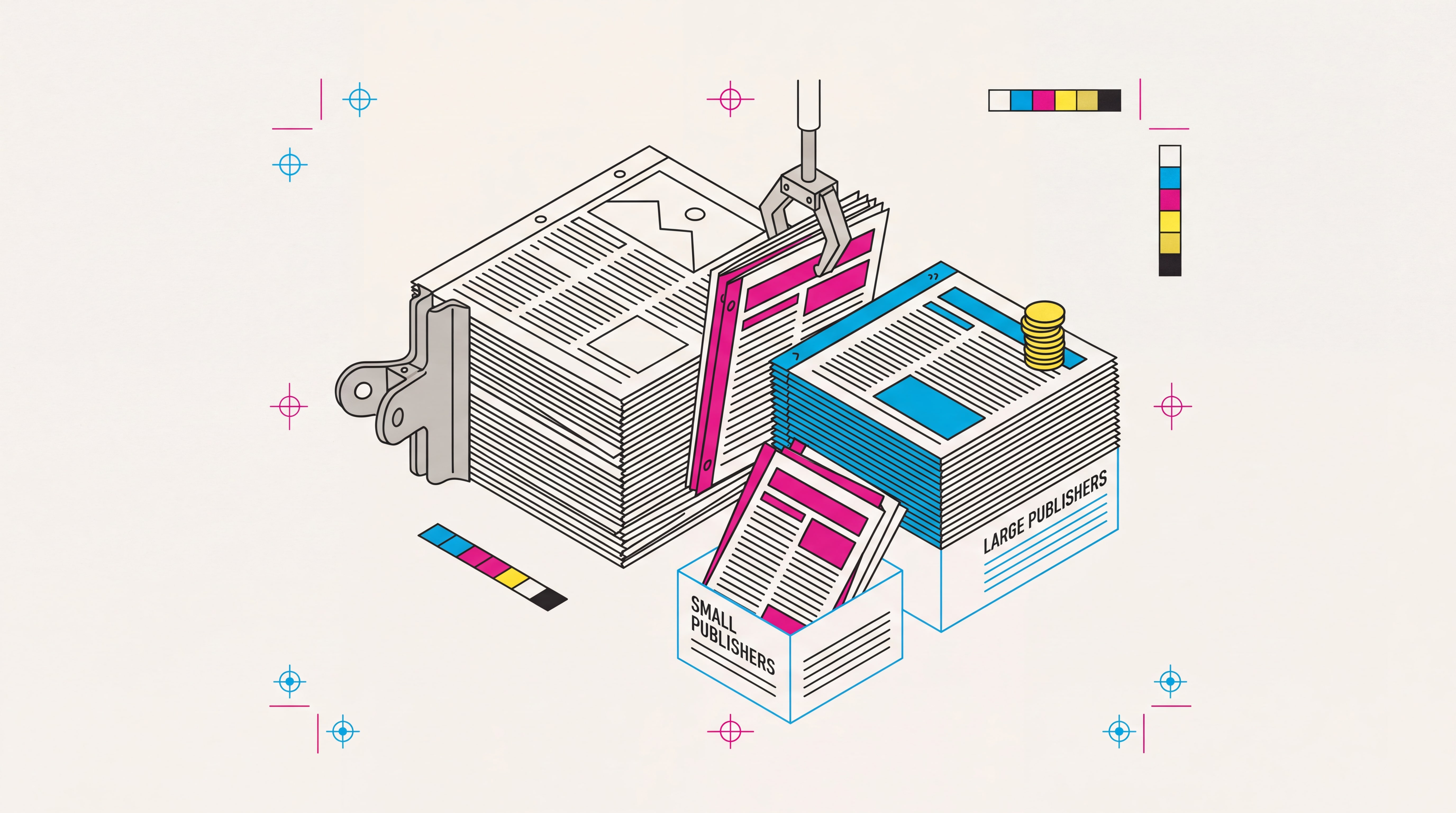
Google's AI Mode, fully integrated using the Gemini 3.5 Flash model since May 19, 2026, has done something no previous algorithm update managed: it has made the referral web functionally obsolete for a significant tier of publishers. The data released in September and October 2026 is not ambiguous. Small publishers — those with fewer than 10,000 daily pageviews — have suffered a 60% collapse in referral traffic. Medium-sized publishers are down 47%. Large incumbents have lost 22%. These are not comparable events happening at different intensities. They are different events entirely.
The Collapse Is Tiered by Design, Not Accident
The 22% decline at large publishers is painful but survivable. It is the kind of number a finance team can model, a board can absorb, and an editorial strategy can adapt to. The 60% figure for small publishers is not a setback — it is, for many, a terminal condition. A niche membership magazine, a regional news outlet, an independent B2B trade publication: any one of these built on a model where Google referrals drove 40% or more of their audience acquisition has had that model destroyed in a single product cycle.
The mechanism is straightforward. Google's AI Mode now synthesises an answer at the point of search, drawing on indexed content without routing the user to a source. The result is a 93% zero-click rate within AI Mode as of late October 2026 — meaning only 7 in every 100 users who receive an AI-generated response click through to any publisher at all. Google Search referrals to news publishers have dropped from 51% of traffic in 2023 to 27% by October 2026. That is not gradual decline. That is the removal of a category.
Yahoo CEO Jim Lanzone, speaking on October 25, 2026, described the situation as an 'existential issue,' citing traffic drops of 60% to 70% for some publishers in his view of the market. The language is accurate. When the primary mechanism by which readers discover your publication stops functioning, the question is no longer how to optimise — it is whether the publication remains viable at all.
The Zero-Click Terminal Changes Everything About Ad Models
The 93% zero-click rate is the number that should end the debate about whether AI Overviews are a threat or an opportunity for publishers. At that friction rate, Google has effectively become an information terminal: a closed system where the query is answered and the session ends. Your content is the input. The answer is the output. You do not appear in the transaction.
For ad-supported publishers, this is an accounting problem as much as an editorial one. Display advertising revenue is denominated in pageviews and sessions. When referral traffic from your largest single source drops by 60%, the advertising model built around it collapses at a similar rate. The CPM — the cost per thousand impressions an advertiser pays — is irrelevant if the impressions are no longer being generated. The revenue simply does not arrive.
The category sensitivity makes this worse for specialist publishers. AI Overviews were already triggering on more than 80% of healthcare and B2B technology queries by May 2026 — exactly the high-value, high-intent verticals where independent trade and specialist titles have historically charged premium rates. The advertisers chasing those audiences are now reaching them through Google's interface, not yours.
Google's Remedies Do Not Address the Structural Problem
In October 2026, Google introduced 'Preferred Sources' designations and specific link-prominence updates, framed as measures to support quality journalism. The European Publishers Council, which filed a formal antitrust complaint against Google on February 10, 2026, targeting the traffic-depriving architecture of AI Mode, represents the regulatory pressure behind these concessions. Both responses deserve acknowledgement. Neither addresses the core issue.
Preferred Sources status may increase the probability that a given publication is cited in an AI Overview. It does not change the 93% zero-click rate. It does not restore the referral relationship. At best, it trades brand visibility in Google's interface for the traffic that interface used to send. That is not a business model. It is a consolation.
The antitrust route is necessary and the European Publishers Council is right to pursue it. It is also slow. Regulatory proceedings operate on timescales measured in years. Your Q4 traffic report does not.
The Only Sustainable Response Is Audience Ownership
The publishers who will survive this are not the ones who find a better way to appear in AI Overviews. They are the ones who stop treating Google as part of their distribution infrastructure at all.
This means redirecting the resources previously spent on SEO — content shaped to rank, structured data designed to feed crawlers, editorial calendars built around search volume — toward direct audience relationships. Newsletters with genuine subscriber bases. Apps that push content without requiring a search. Community models where the audience has a reason to return that has nothing to do with a query they typed into Google. Membership structures where the value proposition is explicit and the transaction is direct.
Google deployed 'Generative AI Performance Reports' in Search Console on June 3, 2026, allowing publishers to track AI-specific impressions. Use it to understand what you have already lost. Do not use it to optimise for a platform that has classified your content as raw material rather than a destination.
The distinction between publishers who own their audiences and those who rent them from Google has always mattered. It is now the only distinction that determines whether a publication has a future. Stop building for someone else's platform. Build your own walls, or accept that you are producing content for Google's benefit, not your own.
More from the Journal